
Investors Do Not Fund Potential Alone #
Many private companies believe they are attractive to investors because they have a good business, loyal customers, strong ideas, or large growth potential. While these things matter, they are not enough on their own.
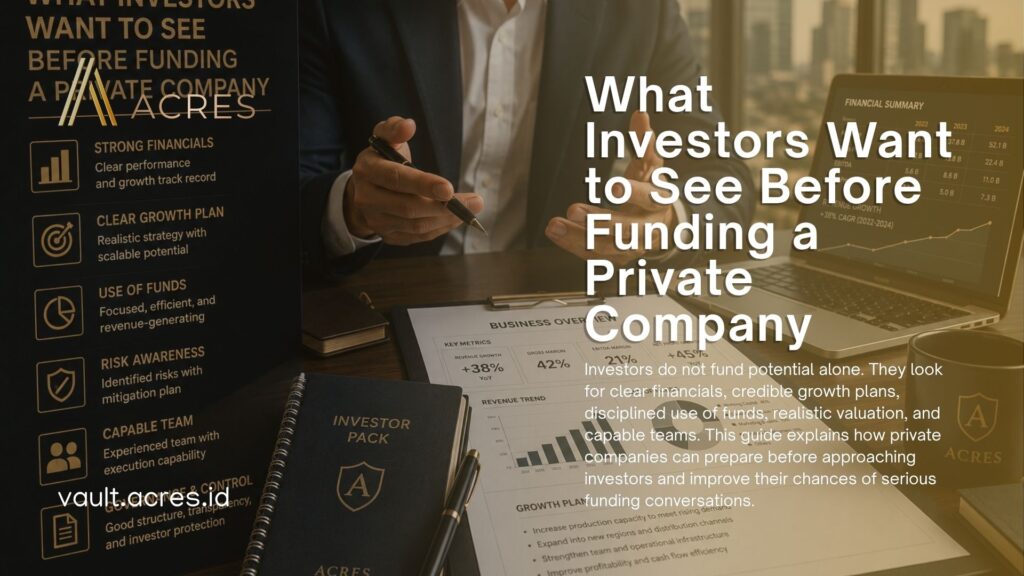
Investors do not fund potential alone. What investors want before funding a private company is potential that can be understood, measured, structured, and protected.
A private company may have real opportunity, but if the information is unclear, the use of funds is vague, or the owner cannot explain how the capital will create value, investors will hesitate. This is especially true for strategic investors, family offices, private capital groups, and operators who evaluate opportunities carefully before committing capital.
Understanding what investors want before funding a private company is important for any business owner preparing to raise capital.
Investors are not only asking, “Is this company interesting?” They are asking deeper questions: Is the business credible? Is the owner realistic? Is the growth plan clear? Can the numbers be trusted? Is the risk acceptable? What happens after the money is invested?
The stronger the answers, the easier it becomes to move from curiosity to serious discussion.
Why Investor Readiness Matters #
A company does not need to be perfect before approaching investors. But it does need to be ready.
Investor readiness means the business can explain itself clearly and professionally. It means the owner understands the company’s performance, capital needs, risks, and growth plan. It also means the opportunity is presented in a way that investors can evaluate without unnecessary confusion.
Many Indonesian businesses are commercially strong but prepares for fundraising without knowing what investors want before funding a private company. They may have customers, revenue, projects, and demand, but their financial reporting, business presentation, valuation logic, and funding structure are not ready for investor review.
This creates a gap in investor readiness.
The owner sees a growing opportunity that is ready for business fundraising in Indonesia. The investor sees incomplete information.
That gap can reduce trust, delay discussions, or weaken the company’s bargaining position. A business that is not properly prepared may receive lower valuation expectations, stricter terms, or no serious offer at all.
Investor readiness is not about making the company look bigger than it is. It is about making the opportunity clear, credible, and investable.
The Common Reasons Investors Say No #
Investors usually reject opportunities not because the business is bad, but because the risk is unclear or the opportunity is not properly explained.
This often happens when key assumptions are not supported by data or when the business model lacks clarity. Clear communication and well-structured information can significantly improve how investors perceive the opportunity.
1. Unclear Financial Performance #
Investors want to understand how the company makes money.
They will usually look at revenue, gross margin, operating expenses, profit, cashflow, debt, receivables, payables, and historical performance. If the company cannot provide clear financial information, investors may assume the business is risky.
This does not mean every private company needs perfect institutional reporting. But the owner should be able to explain the numbers confidently and consistently.
If revenue is growing but profit is weak, explain why. If the company is profitable but cashflow is tight, explain the working capital cycle. If margins changed, explain what happened.
Clarity builds confidence.
2. Vague Use of Funds #
One of the biggest mistakes in fundraising is saying, “We need capital for expansion” without explaining what expansion means.
Investors want to know exactly how the funds will be used. Will the money support working capital, inventory, equipment, new branches, marketing, hiring, technology, debt restructuring, or production capacity?
More importantly, investors want to know how each use of funds connects to business growth.
A strong use of funds plan should show how capital will increase revenue, improve margins, unlock capacity, reduce bottlenecks, or strengthen cashflow. If the money only goes into vague overhead or unclear spending, investors will be more cautious.
3. Unrealistic Valuation Expectations #
Many fundraising conversations fail because the owner and investor have very different views of valuation.
Owners often value the company based on effort, future potential, or emotional attachment. Investors usually value the company based on financial performance, risk, growth visibility, market comparables, and expected return.
A company can ask for an ambitious valuation, but it must be supported by logic.
If the valuation is too high without evidence, investors may assume the owner is not ready for a serious transaction.
4. Founder Dependency #
Private companies often depend heavily on the owner. The founder may control sales, operations, finance, supplier relationships, hiring, and key customer relationships.
This can be a risk.
Investors want to know whether the business can grow beyond the founder. They will look for management depth, team structure, operating systems, reporting discipline, and whether the company can continue performing if the owner is not involved in every decision.
Founder strength is valuable, but founder dependency can reduce investor confidence.
5. Weak Governance and Legal Structure #
Investors need to understand what they are investing into.
This includes company structure, ownership, licenses, permits, contracts, tax position, shareholder arrangements, debt obligations, and legal risks. If the structure is unclear, investors may delay or stop the process.
Good governance does not mean the company needs to operate like a public corporation. It means basic rights, responsibilities, reporting, approvals, and investor protections are clear.
What Investors Want to See Before Funding a Private Company #
A strong fundraising process should answer the most important investor questions before they have to ask too many times.
A Clear Business Model #
Investors want to understand what the company sells, who the customers are, how revenue is generated, and why the business has room to grow.
The explanation should be simple. If the owner cannot explain the business model clearly, investors may assume the business itself is unclear.
Evidence of Market Demand #
Investors want proof that the company is solving a real market need.
This can come from existing clients, repeat orders, signed contracts, occupancy rates, revenue growth, purchase orders, customer retention, or strong sales pipeline. For private companies, real traction matters more than attractive presentation design.
The stronger the evidence of demand, the easier it is for investors to believe in future growth.
A Practical Growth Plan #
Investors want to see how the business will grow after funding.
A good growth plan should not be abstract. It should explain what the company will do, how much capital is required, what milestones will be targeted, what risks exist, and how performance will be measured.
The best growth plans are specific and operational.
A Credible Use of Funds #
Investors want to know that their capital will be used responsibly.
A credible use of funds plan separates revenue-generating needs from general overhead. It shows what funding is needed, why it matters, and how it supports the company’s growth path.
For many private companies, working capital can be very attractive if it directly supports confirmed demand, larger orders, project execution, or faster revenue cycles.
Realistic Deal Structure #
Funding does not always need to be simple equity.
Depending on the company and investor, the structure may involve minority investment, staged funding, convertible instruments, revenue-sharing, strategic partnership, preferred shares, or a combination of capital and operational support.
The right structure should protect both sides. The owner should not give up unnecessary control, and the investor should have enough protection to justify the risk.
How ACRES Helps Companies Become Investor-Ready #
ACRES helps private companies prepare, position, and present investment opportunities to relevant investors, buyers, and strategic capital partners.
We help owners clarify the fundraising objective, review the business case, structure the use of funds, prepare investor-facing materials, and approach selected parties through a more controlled process.
For business owners, this means the company is not introduced randomly or prematurely. The opportunity is first understood, screened, and positioned before investor conversations begin.
For investors, this means they receive clearer opportunities with better context and a more disciplined presentation.
ACRES focuses on strategic fit, confidentiality, and investor readiness, not mass fundraising exposure.
Business Fundraising in Indonesia: Prepare Before Asking for Capital #
The best time to prepare for business fundraising in Indonesia is before speaking to investors.
A private company does not need to be perfect, but it must be understandable, credible, and structured. Investors want to see clear financials, a practical growth plan, realistic valuation logic, responsible use of funds, and an owner who understands both opportunity and risk.
If your company is preparing to raise capital, ACRES can help assess whether the business is investor-ready and how the opportunity should be presented to relevant capital partners.
Connect with ACRES to prepare your company for investor introduction and explore strategic funding opportunities.